Your Story Matters More Than Your Skills in Gaming
Your skills are not what’s getting you hired, promoted, or noticed. In gaming, everyone’s got skills. Skills are the baseline. Everyone can write code or design levels or manage budgets.
What actually sets you apart is the story you tell about those skills.
Two candidates. Same resume. Same technical abilities. One says, “I’m a Unity developer with five years of experience.” The other says, “I’m a Unity developer who spent five years turning impossible deadlines into shipped games that players love.”
Who are you hiring?
The first candidate is forgettable. The second is someone you remember. The second is someone who’s solved real problems under pressure. The second is someone you want on your team.
Every Career Has a Narrative
Your personal narrative is built from the real challenges you’ve faced, the lessons you’ve learned, the unique perspective you bring. It’s not about being flashy or self-promotional. It’s about being real.
I could just say I worked at Riot Games. That’s resume filler. What actually resonates is the story behind that. How I started in advertising, survived a literal earthquake in Nepal, and realized I wanted to do work that actually mattered to me. That story explains WHY I’m in gaming. It makes me human. It makes me memorable.
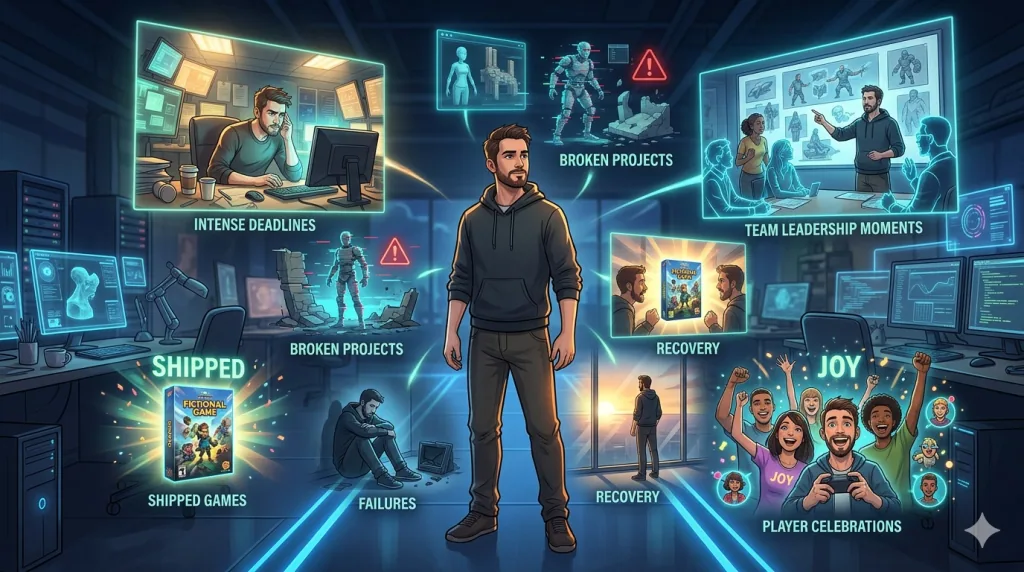
Your career isn’t a list of jobs. It’s a journey. And the best part about a journey is that it’s got obstacles, breakthroughs, and transformation. That’s story material.
Strong storytelling starts with strong communication. Learn how writing can become one of your biggest competitive advantages in game development and help you communicate your ideas, leadership, and impact more effectively.
The Framework: Challenge, Choice, Change
A great career story follows three beats. This is the structure that sticks in people’s heads.
Challenge: What obstacle did you face? What made your job hard? What nearly broke you?
“I was brought into a project that was completely broken. The team was dysfunctional. The code was a disaster. We were three months from launch and shipping felt impossible.”
Choice: What decision did you make to overcome it? What did you do differently? What action did you take?
“I rebuilt our team dynamics from scratch. I created a clear technical roadmap. I started daily standups that actually meant something. I made hard calls about cutting features that weren’t working.”
Change: How did it transform you or your work? What was different on the other side?
“We shipped on time. The game launched to strong reviews. The team went from burning out to having genuine momentum. And I learned that leadership under pressure is about clarity, not perfection.”
That’s challenge, choice, change. That’s a story. That’s memorable. That’s what gets you hired.
Three Places to Own Your Story
On Your Resume
Don’t list tasks. Frame achievements as part of a story arc.
Instead of: “Led a team of five developers.”
Write: “Transformed a struggling team of five into a high-performing unit that shipped a game three months ahead of schedule by establishing clear technical direction and daily accountability.”
That’s still one line. But it’s a story about leadership under pressure. It tells the hiring manager something real.
In Interviews
When they ask “Tell me about a time you failed,” don’t give them a corporate answer. Give them a real story. Walk them through the challenge you faced. The choice you made. The change that came from it.
“I shipped a feature that broke in production two days after launch. I made the choice to immediately own it. I spent the weekend fixing it. I learned that speed matters less than stability. That changed how I approach shipping.”
That’s three minutes. It’s real. It builds trust.
In Your Personal Brand
Every LinkedIn post, every portfolio piece, every conversation is an opportunity to tell your story. Not all at once. But in layers. Over time. Your story becomes visible to the people who matter.

Three Mistakes People Make With Their Story
Mistake One: Making Yourself the Hero
Your story should show how you help others win. It’s not about you being amazing. It’s about you solving problems that matter.
Don’t say: “I’m a genius-level designer who revolutionized our design process.”
Say: “I identified that our design handoff was creating bottlenecks. I built a system that cut iteration time by 40%. That freed the team to focus on what actually moved the needle.”
See the difference? You’re not the hero. You’re the person who solved the problem.
Mistake Two: Being Too Generic
“I worked on a challenging project and learned to be a better team player.”
That could be anyone. That’s forgettable.
“I was assigned to fix a multiplayer netcode issue that had been haunting the project for six months. Every solution we tried failed. I started from first principles. I discovered that the core architecture was the problem, not the implementation. That led to a redesign. We shipped stable multiplayer three weeks ahead of schedule.”
That’s specific. That’s real. That’s memorable.
Mistake Three: Oversharing
Keep it professional. This isn’t therapy. This is career storytelling.
You don’t need to talk about your divorce or your depression or your financial crisis. But you can talk about overcoming adversity. You can talk about what you learned. You can be human without being inappropriate.
Your Homework
Take 15 minutes this week. Write down a real challenge you faced in gaming. The kind that nearly broke you or made you rethink everything.
Then write down the choice you made. What did you actually do about it?
Then write down the change. How did it transform you or your work?
You’ve just captured your story. Now you can use it everywhere. On your resume. In interviews. In your personal brand.
Your Move
Your skills might get you in the door. But your story is what keeps that door open. Your story is what makes hiring managers remember you. Your story is what separates you from everyone else who can code or design or manage.
Craft it. Own it. Tell it everywhere.
Read our complete guide: Gaming Professional Visibility
Frequently Asked Questions
Q: Why do skills matter less than story when getting hired or promoted?
A: Skills are baseline, everyone’s got them. Two developers with identical skills apply for a role, but one just says they have five years of experience while the other talks about turning impossible deadlines into shipped games that players love. The second one gets the job because story makes people want to bet on you.
Q: What is the challenge, choice, change framework and how do you use it?
A: Challenge is the obstacle you faced. Choice is the decision you made to overcome it. Change is how it transformed you or your work. This structure turns your achievements from a list of tasks into a narrative that shows your character, values, and growth. Use it on your resume, in interviews, and across your personal brand.
Q: How should you frame achievements on your resume instead of just listing responsibilities?
A: Don’t just say you led a team of five developers. Instead frame it as transformed a struggling team of five into a high performing unit that shipped a game three months ahead of schedule. You’re showing impact and change, not just what was on your job description.
Q: What’s the biggest mistake people make when telling their career story?
A: Making yourself the hero of the story. Your story should show how you help others win, your team, your players, your community. Focus on impact you’ve had, not how great you are. Details make it memorable, but vulnerability doesn’t mean therapy sessions.
Q: How specific should you get when telling your career stories?
A: Very specific. Don’t say you improved a feature, talk about the time you turned a buggy mess into a polished feature or how you rallied a team during crunch time. Details are what make your story stick in people’s minds, not generic statements that could apply to anyone.