How to Actually Use ChatGPT to Fix Your Gaming Resume (Without Sounding Like a Robot)
If you’re in gaming and you’ve used ChatGPT to write your resume, there’s a 90% chance it looks like everyone else’s. Generic, lifeless, and headed straight for rejection.
But AI can be a secret weapon if you know how to use it right. The problem isn’t the tool. It’s how people use it. They ask the AI to write their entire resume from scratch and end up with two major problems. First, every resume sounds vague yet somehow impressive with no real details. They all sound the same. Second, AI hallucinates. People end up with straight up lies on their resume about experience that never happened. Then they show up to interviews unable to explain any of it.
Here’s the system that actually works.
Step 1: Draft Your Resume Yourself First
Your resume must reflect your actual experience. If it doesn’t match reality, you might get the interview but you won’t get the job.
Start with this basic template. Contact information at the top. Then 4 to 5 career highlights showing your biggest wins. Work experience in reverse chronological order with your most recent role getting 5 to 7 bullet points, the next two roles getting 4 to 5 each, and everything else getting a maximum of two bullets. Education and noteworthy skills at the bottom. That’s it.
People over-complicate resumes when the readers are quite simple creatures themselves. Fill this out with your REAL experiences before moving forward.
Step 2: Give AI a Gaming-Specific Persona
Instead of generic ChatGPT, set it up properly. Use a prompt like: “You are an expert resume writer with 20 years of experience helping gaming professionals land jobs at Riot, Blizzard, and PlayStation.” Adjust for your specialty, whether that’s production, design, engineering, or whatever you’re focused on.
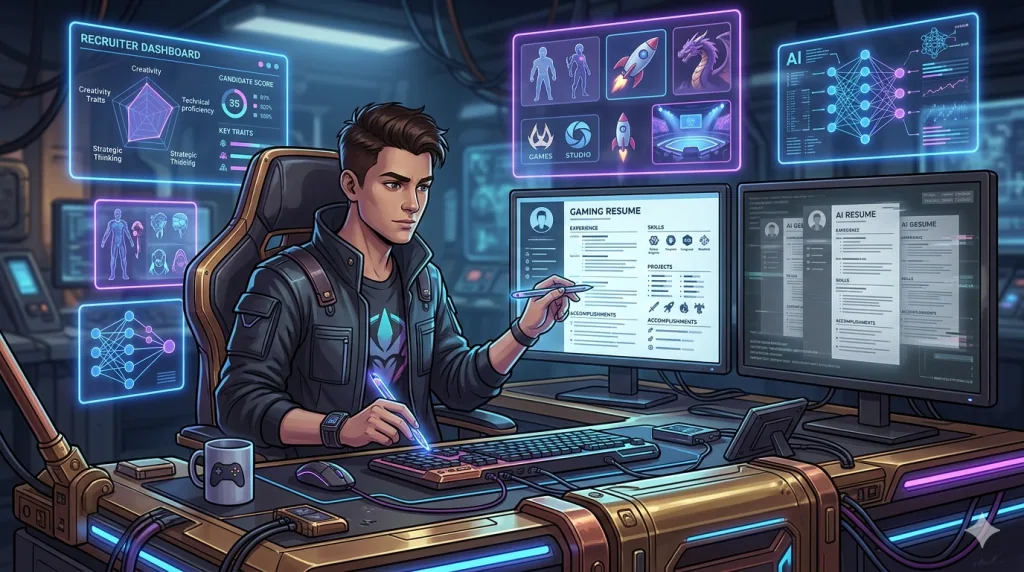
This context makes the responses 10 times sharper. And if you know the hiring manager’s name, make it even more specific. The AI will tailor the language to what will impress that specific person.
Step 3: Transform Tasks Into Accomplishments
Most people think resumes are just a list of tasks they’ve done. But recruiters don’t want to see what you were assigned. We want to be impressed by what you actually accomplished.
“Work on UI design for an RPG project” is a task. “Redesigned RPG UI flow reducing player onboarding time by 40% and increasing tutorial completion rates” is an accomplishment. See the difference?
Paste one job at a time and ask the AI: “Do the following bullet points sound like accomplishments or tasks? Convert every task into an achievement.” But here’s where you need to be careful. Don’t let AI invent accomplishments for you. AI is designed to please you, so it’ll happily make up impressive-sounding wins that never happened. Only you know what you actually did.
The “So What?” Test That Changes Everything
When I’m speed-reading resumes, I’m constantly asking “so what?” This is especially brutal in gaming where candidates get obsessed with the tech instead of the impact.
“Built a playtesting tool in Unity” makes me ask so what. “Built a playtesting tool that cut QA cycles by 20%, helping the team ship 2 weeks ahead of schedule” makes me stop and pay attention.
Ask the AI to suggest ways to add results or outcomes to each bullet point. Then refine and review each suggestion carefully. Quantify everything you can. Aim for 60% of your bullets to include measurable outcomes.
Beat the ATS Without Keyword Stuffing
Copy the job description and ask the AI to list the top 20 keywords you should include. Then weave at least 60% of those terms into your resume naturally, but only if they apply to your real experience.
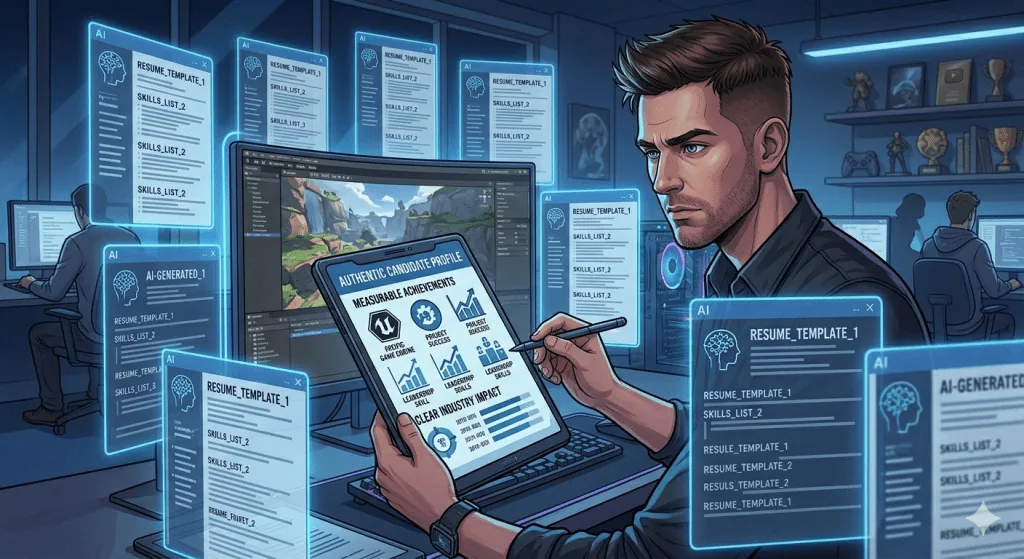
Here’s the mistake everyone makes. They create a skills section and dump all the keywords in there. ATS systems and hiring managers can both spot this from a mile away. It makes recruiters tune out. You have to integrate keywords throughout your highlights, work experience, and project details.
“Managed stakeholder expectations across five departments during major engine migration” is WAY more credible than just listing “stakeholder management” as a skill.
Skip the Professional Summary (It’s a Trap)
Professional summaries are magnets for filler words. “Motivated professional with strong communication skills.” I’ve seen that exact phrase 50 times in a month. These phrases mean nothing.
Instead, create a career highlight section at the top. Your 4 to 5 biggest wins that show impact. Ask the AI: “Based on my work experience, create 10 career highlights that would impress a hiring manager for this role.” Pick the four strongest and quantify those results.
If you follow this system, your resume won’t look AI-generated. Because it isn’t. You’re the author. AI is just your brainstorming partner helping you package your real accomplishments in the most compelling way possible.
Before using AI, make sure you’ve already removed the things hurting your resume.
Read our complete guide: Gaming Professional Visibility Guide
Q: Should I use ChatGPT to write my entire gaming resume?
A: No. If you do, it’ll sound like everyone else’s. Draft your resume yourself first with real experiences, then use AI to polish and transform tasks into accomplishments. You’re the author. AI is just your brainstorming partner.
Q: How do I stop my AI-written resume from sounding generic?
A: Give ChatGPT a gaming-specific persona first. Prompt it with something like “You are an expert resume writer with 20 years helping gaming professionals land jobs at Riot, Blizzard, and PlayStation.” This context makes responses 10 times sharper.
Q: What’s the “so what” test for a gaming resume?
A: For every bullet point, ask “so what?” If the answer is just “I did my job,” rewrite it. “Built a playtesting tool in Unity” is weak. “Built a playtesting tool that cut QA cycles by 20%” makes a hiring manager stop and pay attention.
Q: How do I use ChatGPT for ATS keywords without keyword stuffing?
A: Ask AI to list the top 20 keywords from the job description. Then weave them naturally into your highlights and work experience. Don’t dump them in a skills section. Show them in bullet points like “Managed stakeholder expectations across five departments.”
Q: Should I include a professional summary on my gaming resume?
A: No. Professional summaries are traps filled with filler words like “motivated professional with strong communication skills.” Replace it with a career highlight section of 4 to 5 of your biggest wins that show measurable impact.
Q: Can ChatGPT be a career coach?
A: It can be a useful career assistant, not a coach. ChatGPT is excellent at editing what you give it: sharpening bullets, suggesting keywords, stress-testing your “so what”. But it gives everyone the same vague-yet-impressive advice, it hallucinates experience you never had, and it can’t see the blind spots you’re carrying, because it only knows what you tell it. Use AI as the editor and keep a human, whether a coach or a trusted industry peer, as the one who challenges your actual positioning.