Gaming Resume Writing Guide
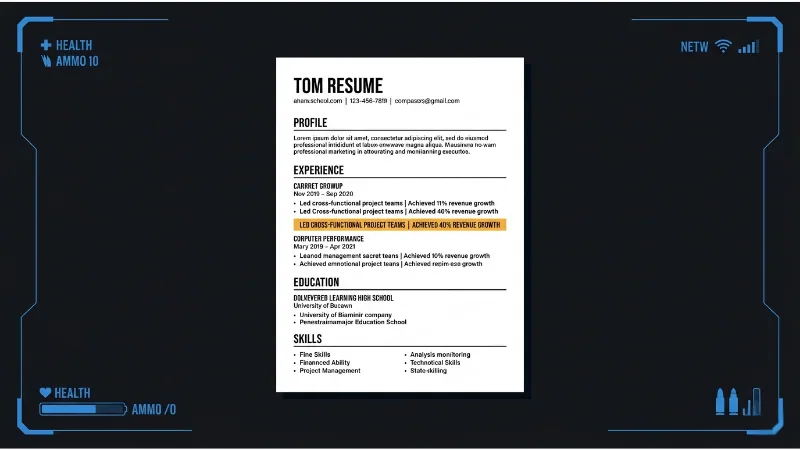
I’m an ex-Riot Games hiring manager. I reviewed 800 gaming resumes and kept track of what actually landed interviews. This guide is the result. Free, no signup, built to be used before you hit apply. Every gaming resume you send gets about 7 seconds. Someone at a studio is scrolling through a stack of forty, all blending together, and yours has one job: MAKE THEM STOP. After reviewing more than 800 gaming resumes as a hiring manager at Riot Games and now as a coach to gaming professionals across design, engineering, art, production, marketing, and QA, the patterns are dead consistent. A small set of choices lands interviews. A different set gets you skipped. This guide walks through exactly what works, what to cut, and how to write a gaming resume that survives the 7-second skim. Plus deeper dives on each pattern.
Most of the resumes I see are technically fine. The experience is there. The studios are there. The work is real. What’s missing is the translation layer: turning what you did into what a hiring manager needs to see in seven seconds. That’s a fixable problem. None of what follows requires you to rewrite your career. It requires you to rewrite how you describe it, and to stop letting generic, task-listed bullets undersell work you’re already proud of.
What 800 resume reviews taught me.
- You get about 7 seconds. That is how long a screener looks before deciding to keep reading or move on.
- 90% of resume bullets fail the “So What?” test. They describe activity, not impact.
- The resumes that landed interviews had receipts. Numbers, not adjectives.
- Aim for a measurable outcome in at least 60% of your bullets.
Full teardown: What 800 Gaming Resumes Taught Me
Print the checklist before you apply: checklist
What makes a gaming resume different from a regular resume?
Gaming resumes get judged against shipped titles, team credits, and portfolio work in ways generic tech resumes never touch. A recruiter at a studio isn’t just checking whether you can do the job. They’re checking whether you’ve done it in production. Whether you’ve shipped under pressure. Whether you know what a Monday after launch actually feels like.
That changes what matters on the page.
Three signals a hiring manager scans for first:
- Recognizable games: if you worked on something they know, even in a small role, you get instant credibility.
- Measurable impact: “improved matchmaking” is vague, “reduced matchmaking wait times by 37%” is real.
- Familiar studios: a name they’ve heard tells them you’ve been vetted by someone they respect.
Generic tech resumes can lean on years of experience, certifications, and framework familiarity. Gaming resumes don’t. A three-year veteran who shipped a multiplayer update that cut server costs 22% beats a ten-year veteran who never touched a live product. Years don’t carry weight here. Shipped work does.
Different disciplines also look for different signals. Before tailoring your resume, it helps to browse open roles by discipline to see what studios are actually hiring for.
Team scale is its own signal. Working on a 200-person AAA team tells me something different than leading a five-person indie from prototype to launch. Both are valuable. Neither replaces the other. Call out the size of the team you shipped under, the scope of the project, and the part you personally owned. “Owned combat design for a six-person vertical slice” reads cleanly. “Combat designer, AAA action title, 150-person team” reads cleanly. Ambiguity about your actual role is where resumes get quietly deprioritized.
If your resume reads like a list of responsibilities at studios the reader has never heard of, you’re invisible. Gaming is a small industry that cares about receipts. The resume that wins leads with the credits and builds the story around them. This is also why a gaming resume is part of the wider visibility problem that keeps gaming professionals hidden. Signal is how you win.
The “So What?” test that kills 90% of gaming resume bullets
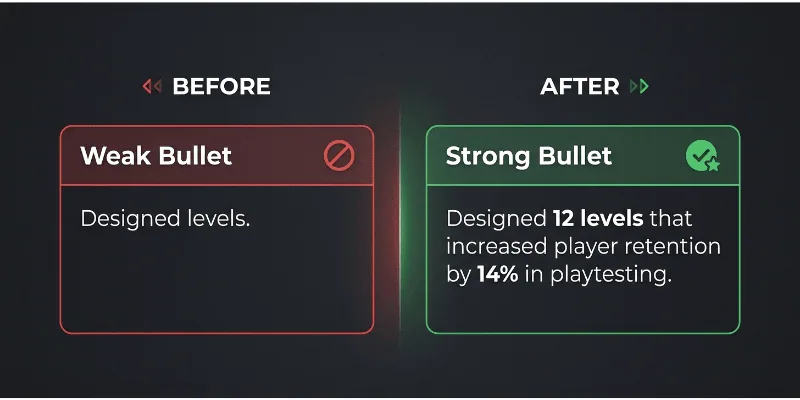
Most gaming resumes are task lists. “Designed levels.” “Tested for bugs.” “Built features.” Hiring managers aren’t looking for task doers. I’m looking for people who moved the needle. That gap between task and impact is where 90% of gaming resumes die on my desk.
Here’s the drill. After every bullet, ask “So what?”
“I designed levels.” So what? “I designed levels that boosted player retention by 14%.” Now I’m reading.
“I tested for bugs.” So what? “I found bugs that helped secure 94% positive Steam reviews at launch.” Now I’m reading.
“I built a playtesting tool.” So what? “I built a playtesting tool that cut QA cycles by 20% and helped ship two weeks ahead of schedule.” Now I’m reading.
The pattern is outcome-focused. What did your work produce? Whose job got easier? What number moved? What launched because of what you did?
This is brutal on gaming resumes in particular because gaming culture rewards craft obsession. People list the tools. The engine. The pipeline. The tech stack. None of that tells me whether the thing you worked on actually worked. Nobody cares you used Unity. They care what you shipped with it.
Run the “So what?” test on every bullet before you hit send. If the answer is “I did the task my job description said to do,” rewrite it. If you can’t come up with a so-what for a bullet at all, it probably doesn’t belong on the resume.
See the full teardown of patterns from 800 resume reviews.
What to remove from your gaming resume
Your resume has exactly one job. It’s not your life story. It’s not a Wikipedia page. It’s a marketing document that earns you an interview. Every line that doesn’t serve that job is costing you.
Three categories of stuff to cut, in priority order.
Bad judgment signals. Flashy graphic art and clip-art characters. Unprofessional email addresses (no HelloKitty246 and no variations). Multi-column layouts that break ATS parsing. A two-column resume might look sleek, but if the ATS drops half your keywords, you might as well not have applied. Even if you’re a graphic designer, keep the flourishes in your portfolio and let your resume do the clean talking.
Bias triggers. Headshots. Marital status. Number of kids. Religion. Your full mailing address. Recruiters are people. People carry biases even when they’re trying not to. Your job is to keep the door closed on anything that lets bias in before your work gets read. City and time zone are fine. Street address is not.
Irrelevant oversharing. Work history older than ten years. Your college GPA and graduation year. Clubs you joined as a freshman. Volunteer work that has nothing to do with the role. And the skills word salad: “Microsoft Office, problem solving, communication, passionate about gaming.” None of that means anything to a hiring manager.
One client in his mid-forties fought me hard about keeping his internship from twenty years back. He wanted the recruiter to see his humble beginnings. I asked him one question: when you interview someone, do you care what they did in 2005? He cut it that afternoon.
The simpler the resume, the stronger the impression. Cut fluff. Keep wins. Position yourself as a safe bet in under seven seconds.
Full list: what to cut from your gaming resume.
How to quantify gaming work (numbers are receipts)
Numbers do three things at once. They prove impact. They build credibility. They speak the industry’s language. Gaming runs on DAU, ARPU, D7 retention, churn, CPI, session length. When you put those numbers on the page, you stop sounding like a candidate and start sounding like a practitioner.
The pattern I teach is impact, scale, velocity. Impact is the outcome (“cut load times by 42%”). Scale is the size (“across 2 million players”). Velocity is the speed (“shipped two weeks ahead of schedule”). The strongest bullets stack two or three of these. “Led monetization strategy that lifted ARPU 12% across 2 million players.” Done. That’s a receipt.
What if you don’t have exact numbers? Estimate conservatively. A lowball estimate is still more credible than “improved monetization.” Rebuild the number from memory. How many units shipped. How many teammates. How many weeks saved. Rough is fine. Defendable in an interview is the bar.
What if your work is under NDA or pre-release? Describe scope without naming the title. “An unannounced AAA RPG at a top-five publisher.” “A 150-person multiplayer project at a major Japanese studio.” The industry is small enough that your interviewer will often connect the dots on their own, and that’s fine. You haven’t breached.
What if you’re early-career and genuinely have no numbers to point to? Use scale from the projects you did touch. Players in the playtest. Lines of dialogue shipped. Systems delivered per sprint. Scope is a form of credibility when outcome data isn’t yours yet.
Aim for 60% of your bullets to include a measurable outcome. Not 100%. Some wins are qualitative and that’s okay. But if your resume has zero numbers on it, you look like you don’t know what counts as success in this industry. That’s a worse signal than any missing credit.
Numbers aren’t bragging. They’re receipts. Bring them.
Deep dive: adding numbers to your game dev resume.
Should you use ChatGPT to write your gaming resume?
Yes, but not the way most people do. If you ask ChatGPT to write your resume from scratch, you end up with the same vague, vaguely impressive, instantly-skippable voice as every other AI-generated resume in the pile. I see it constantly. Same phrases. Same cadence. Same zero signal.
Use AI as an editor, not an author. The difference is everything.
Draft your resume yourself first. Real experience. Real bullets. Messy is fine. Then bring AI in with a gaming-specific persona. Something like: “You are an expert resume writer with 20 years of experience helping gaming professionals land jobs at Riot, Blizzard, and PlayStation. Your specialty is technical design resumes.” That prompt alone makes the output ten times sharper than generic ChatGPT. If you know the hiring manager’s name and background, add it. The AI will tailor to the human.
From there, work one job at a time. Paste your bullets and ask whether they read as accomplishments or tasks. Ask for ways to sharpen the so-what on weak bullets. Ask for ATS keyword suggestions based on the job description and weave them naturally into your experience. Never dump them in a skills section. ATS systems and hiring managers both spot that from a mile away.
What AI is good at: structure, consistency, keyword coverage, grammar, tightening wordy bullets, suggesting stronger verbs. What AI is bad at: your actual accomplishments, your voice, the specificity that makes a hiring manager stop scrolling. It will happily invent impressive-sounding work you never did. That hallucination risk is why you draft first and use AI to edit second. If a bullet isn’t true, cut it. If you can’t defend it in an interview, cut it.
AI gets you maybe 60% of the way there. You supply the other 40%, which is the part that lands the interview.
How to use AI to fix your gaming resume without making it worse.
Which gaming resume format should you use?
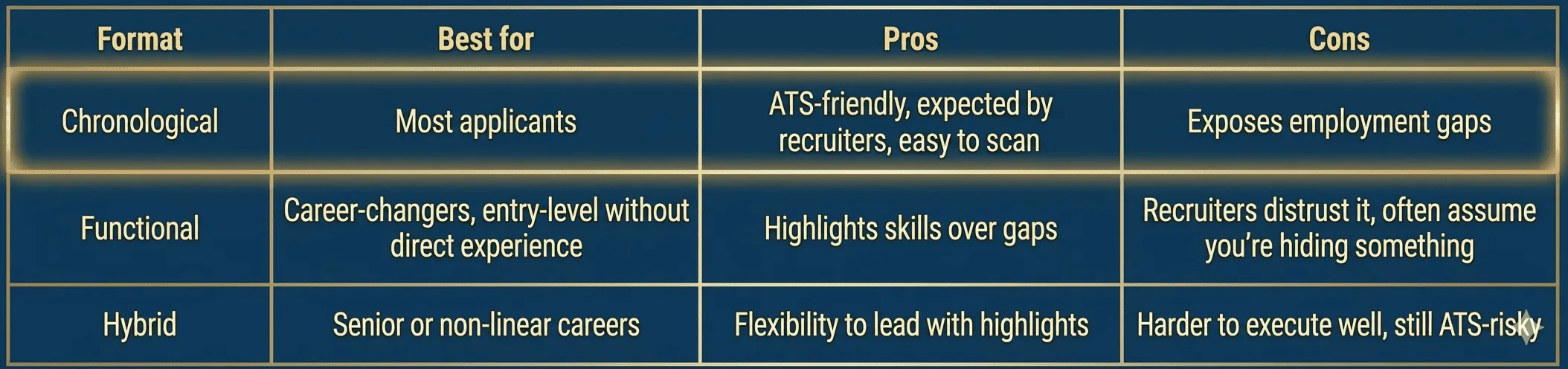
Most gaming professionals should use chronological format. Functional format is a red flag to recruiters and should be avoided unless you’re doing a hard career pivot with no other option. Hybrid is for senior applicants with genuinely non-linear careers.
If you’re trying to break into the industry, reviewing current entry-level gaming jobs before writing your resume can help you understand what employers are asking for today.
Why chronological wins. It’s ATS-friendly. It’s what recruiters expect. It lets them trace your trajectory in the seven seconds they’re going to spend. And it puts your most recent, most relevant work at the top, where it has the best chance of being read.
FAQ
How long should a gaming resume be?
One page for almost everyone…
Do I need a cover letter for gaming jobs?
Only when someone will actually read it…
How do I list indie, modding, or hobby projects on a gaming resume?
Same format as a paid role…
Should I list my gamer tag or online handles?
Only if they’re professionally connected to your work…
How do I handle layoffs or short tenure on a gaming resume?
Stop hiding them…
What is the 7-second rule for gaming resumes?
A screener spends about 7 seconds on your resume before deciding to keep reading or move on. That is the whole window. It means the top third of the page has to carry your best shipped work and your biggest numbers, because nothing lower gets read until the top has earned it. The full framework, with examples of what survives the skim, is at the 7-second rule.
How do you get your gaming resume past ATS screening?
Use chronological format with a single-column layout so the system parses every line. A two-column resume might look sleek, but if the ATS drops half your keywords you might as well not have applied. Then weave keywords from the job description naturally into your experience bullets instead of dumping them in a skills section. ATS systems and hiring managers both spot a keyword dump from a mile away.
What is the 30-second rule for resumes?
The 30-second rule says a recruiter spends about half a minute on your resume before deciding whether to keep reading. In gaming it’s more brutal than that: after 800+ resume reviews, the real window is closer to 7 seconds. Either way, the implication is the same. Keep it to one page, put your best shipped work and biggest numbers at the top, and make every bullet pass the “So what?” test, because nothing below the fold gets read until the top has earned it.
The bottom line. Your resume isn’t the thing that gets you the job. Your resume is the thing that gets you the interview…
For educators and career services
If you run a career center or teach a game program, this guide is free to share. Link it, print it, hand the checklist to students at drop-ins. No signup, no paywall, and it stays that way.
I also do free guest talks for game programs on what studio hiring actually looks like from the inside. Reach me through the about page.