3 High-Leverage Skills That Accelerate Your Game Dev Career
Most career advice is about grinding harder. Work longer hours. Ship more features. Grind more.
That’s not wrong. But it’s also not enough. There are three skills that multiply your grind. Learn these and you’re not just working faster, you’re working smarter. You’re not competing on effort, you’re competing on leverage.
Skill One: Document Your Accomplishments
This is the one people hate doing because it feels arrogant. But your work cannot speak for itself. It needs a voice. It needs you to champion it.
Here’s the system: keep a simple document. Every time you do something that moves the needle, write one paragraph about it.
“In March, I designed a new matchmaking algorithm that reduced queue times by 20% while maintaining 95% match quality.”
That’s it. One sentence. One paragraph at most. You’re not writing a novel. You’re creating a reference.
Why this matters: when you go into a review, when you interview somewhere, when you pitch for a raise, you don’t have to rely on memory. You’ve got a document that proves your impact. You’ve got evidence.
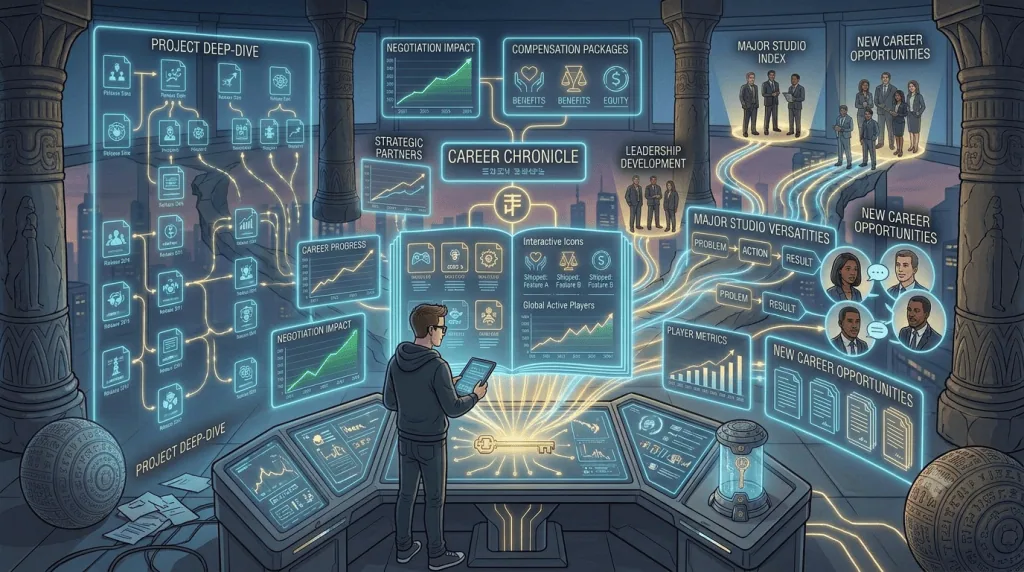
People who move fast in their careers aren’t necessarily more talented. They’re just better at advocating for their own work. They say “here’s what I shipped, here’s the impact, here’s what I learned.”
The tiny time investment is maybe 10 minutes a week. The return is massive when you need to prove your value.
Skill Two: Get Good at Interviewing
Interviewing is advanced communication training disguised as a meeting. Nothing else teaches you active listening, storytelling, and calibration the way interviewing does.
Most people treat interviews as a test they need to pass. Actually, interviews are a conversation. They’re a way to show how you think and work and communicate.
Here’s the grind: practice once a month. Do a real interview. Record yourself. Listen back. See where you stumbled. See where you rambled. See where you were unclear.
If you practice 12 times a year, by the end of the year you’re not nervous anymore. You’re sharp. You know how to answer hard questions. You know how to tell your story clearly.
This isn’t just useful when you’re job hunting. This is useful in every meeting. Promotions, raises, project pitches. The ability to communicate under pressure is EVERYTHING.
And the best way to get good at it is to do it over and over until it doesn’t feel like acting anymore. Until it feels like you’re just being yourself, but sharper.

Skill Three: Get Better at Saying No
People who advance fastest say no to almost everything.
This sounds backwards. But it’s true. Every yes you say is a commitment. And if you’re saying yes to everything, you’re not actually committed to anything. You’re scattered.
The people who move the fastest are the ones who have a clear vision of what matters and say no to everything else.
But you can’t say no blindly. You need a filter. Use impact as your filter.
Ask three questions before you say yes: Is the benefit outsized compared to the effort? Is this a significant favor for someone who can help my career later? Or is it genuinely low effort and I have the bandwidth?
If none of those three are true, say no.
And have scripts ready. “I’d love to help, but I’m deep in a project right now. Can you send me the key points and I’ll catch up after?” Or “That sounds important. I don’t have bandwidth this quarter, but let’s talk in three months.”
You’re not being a jerk. You’re being honest. And people respect honesty more than they respect fake enthusiasm from someone who’s too scattered to be useful.
How These Three Skills Compound
Here’s what happens when you master all three.
You document your accomplishments, so you know your value. You interview well, so people understand your value. You say no to distractions, so you have time and energy to create more value.
That’s the compounding edge. You’re not working harder. You’re working smarter. You’re making your impact visible. You’re communicating it clearly. You’re protecting the time to do more meaningful work.
The game is not about being the most talented person in the room. The game is about being the person who does the MOST meaningful work AND makes sure the right people know about it.
The Move
Pick one skill this month. If it’s documentation, start the brag document tomorrow. If it’s interviewing, schedule one informational interview. If it’s saying no, write down your filter and practice it once.
Don’t try to do all three at once. Build them one by one. But build them intentionally.

In six months, you’ll have a competitive advantage most people never develop. In a year, you’ll be shocked at where your career has moved.
The grind is real. But the leverage is better.
Read our complete guide: Senior Game Dev Career Growth
Frequently Asked Questions
Q: How do I make sure my accomplishments don’t get forgotten at review time?
A: Start a brag document right now. Every time you do something impactful, write one paragraph with where it happened, what it was, and who was involved. Takes 30 seconds. Your manager is juggling dozens of projects and dozens of people, they won’t remember if you don’t tell them. It’s not arrogance if it’s true, and your work cannot speak for itself without you championing it.
Q: Why is interviewing a high-leverage skill for career growth?
A: Because it’s secretly advanced communication training disguised as a meeting. You’re learning active listening, storytelling, calibration, and how to craft narratives for pitches and presentations. These skills translate directly to leading meetings and communicating with senior leadership. Practice both sides regularly, and record yourself to see what you actually sound like, not how you think you sound.
Q: When should I say yes to extra work and when should I say no?
A: Say yes to three things only. First, when there’s massive return on minimal investment like a GDC speaking slot that uses an existing presentation. Second, when it’s a significant favor for someone who controls your future, like your skip-level manager. Third, when you genuinely have bandwidth and it’s truly low effort. Everything else is a no if it doesn’t support your KPIs or your team’s main quest.
Q: How do I know if something is worth my time?
A: Use impact as your filter. Say yes to things that are high impact to your growth, your team, or your career. If it’s not high impact, it’s a no. Most of us are terrible at estimating time anyway, so that quick favor usually turns into three hours you didn’t plan for. Put your own oxygen mask on first or people will just exploit your goodwill.
Q: What’s the fastest way to improve my interview skills?
A: Record yourself answering common interview questions and review the recording. Your brain tricks you about how you actually sound. We think we’re clear when we’re rambling, we think we’re confident when we’re hedging. The recording doesn’t lie. If you’re not in an official interview role, run mock interviews with other job seekers to build the same skills and reflexes.